


deskontroller LITE V3 - Art-Net Pixel Controller 32 Universes images
deskontroller LITE V3 - Art-Net Pixel Controller 32 Universes
The highest-FPS model in the LITE V3 range.
32 physical outputs · 32 Art-Net universes · 16,384 channels · up to 5,440 RGB pixels.
For touring, temporary installs, compact scenic projects and applications where high refresh rate is the priority.
In stock · Free 24h shipping · EU built · 5-year warranty.
Where does 32U fit best?
32U is the right choice when you need low load per output and maximum FPS headroom.
The 32U shares the same 32-output physical architecture as the whole deskontroller LITE V3 range, but works with one universe per output in normal mode. This makes it the cleanest starting point when the project does not need high total capacity and benefits from independent lines, simple patching and the highest FPS headroom. If total capacity may grow later, the 64U is the next step — and the unit can also be upgraded by key without replacing the hardware.
Technical information and support
This product page helps you choose the right model. If you need configuration details, pixel protocols, wiring guidance, downloads or deeper support content, you can open the full technical documentation on deskontroller.com.
What the 32U is and where it fits best
The deskontroller LITE V3 32U is the professional entry point in the range and the model that prioritises low load per output, FPS headroom and simple patching. With one universe per output in normal mode and the same 32-output physical architecture as the full platform, each line carries the lowest load in the family.
It is the right choice when the project does not need high capacity per line, but does benefit from clean distribution, simple architecture and the full 32-output infrastructure of the platform.
- Installations where distributing pixels across many independent lines is the priority
- Projects where FPS performance matters and total pixel count per output is manageable
- Setups that benefit from a clean, low-load architecture per output
- Users entering the deskontroller range who want the most flexible output structure
What this model delivers
In the LITE V3 range, the 32U is the model with the highest FPS and the lowest load per output:
In normal mode, this model works with 1 universe per output. In V1 / clock, it moves to 2 universes per active output, while keeping the same total 32 universes in the controller.
In practical terms, the 32U fits when you want clean distribution, low load per line and maximum flexibility to split the installation across independent outputs.
Upgrade later if your project needs more capacity
Start with the model that fits your project today. deskontroller LITE V3 models from 32U to 160U can be upgraded later to a higher-capacity model, up to 192U, by upgrade key and without replacing the hardware.
The upgrade increases the available universes and model capacity. It does not change the physical output layout: the controller keeps the same hardware platform and the same output distribution logic.
The hardware warranty remains linked to the original purchase date of the unit.
How outputs are distributed in a real installation
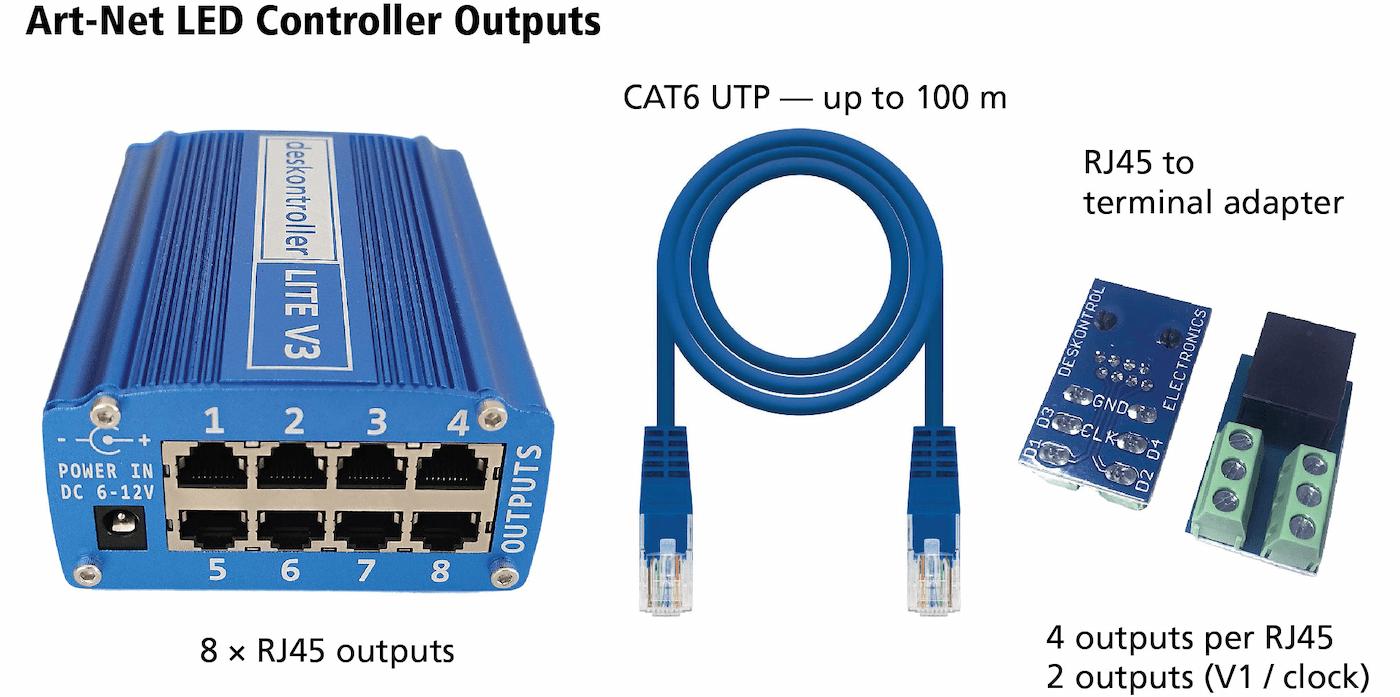
The deskontroller LITE V3 uses the same physical architecture across the whole range: 8 RJ45 output connectors that, through adapters, let you work with up to 32 physical data lines.
In real-world installations, the logic is straightforward: from the controller you run CAT6 UTP to the adapter, and from there you connect the pixel line or lines depending on the operating mode of that port.
- Up to 100 metres of CAT6 UTP between the deskontroller and the adapter, depending on installation conditions
- Normal mode: up to 4 outputs per RJ45 connector
- V1 or clocked families: 2 active outputs per RJ45 connector
- The physical architecture stays the same across all models; what changes is the number of universes per output
This approach helps distribute the installation more cleanly, avoid unnecessary concentration on each line, and take advantage of one of the key strengths of the system: 32 physical outputs to distribute load with real criteria.
Universes per output in the 32U
On the 32U, each output carries the minimum load in the range. In normal mode, every active output maps to a single universe, which means simple patching and the cleanest line structure across the whole family.
| Mode | Active outputs per RJ45 | Universes per output | Approx. capacity per output |
|---|---|---|---|
| Normal mode | 4 | 1 universe | ~170 RGB or ~128 RGBW |
| V1 / clock | 2 | 2 universes | ~340 RGB or ~256 RGBW |
This model is especially useful when you want maximum physical independence between zones or fixture groups, or when FPS performance is a priority and keeping load per line as low as possible is the right approach.
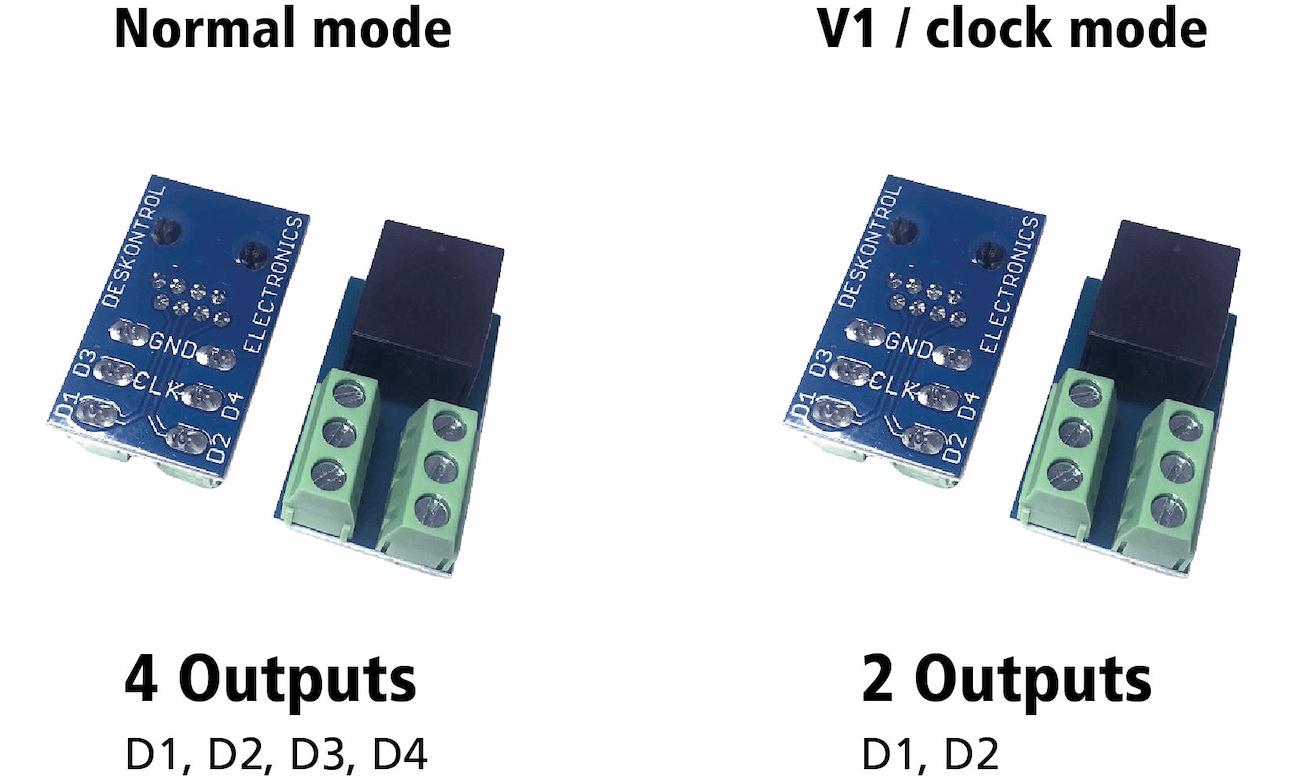
In normal mode, the adapter delivers 4 outputs using D1, D2, D3 and D4. In V1 or clock mode, it works with 2 active outputs using D1 and D2.
The key idea is simple: the physical architecture does not change; what changes is how many universes each output can carry depending on the model.
Integration with standard software and Web UI
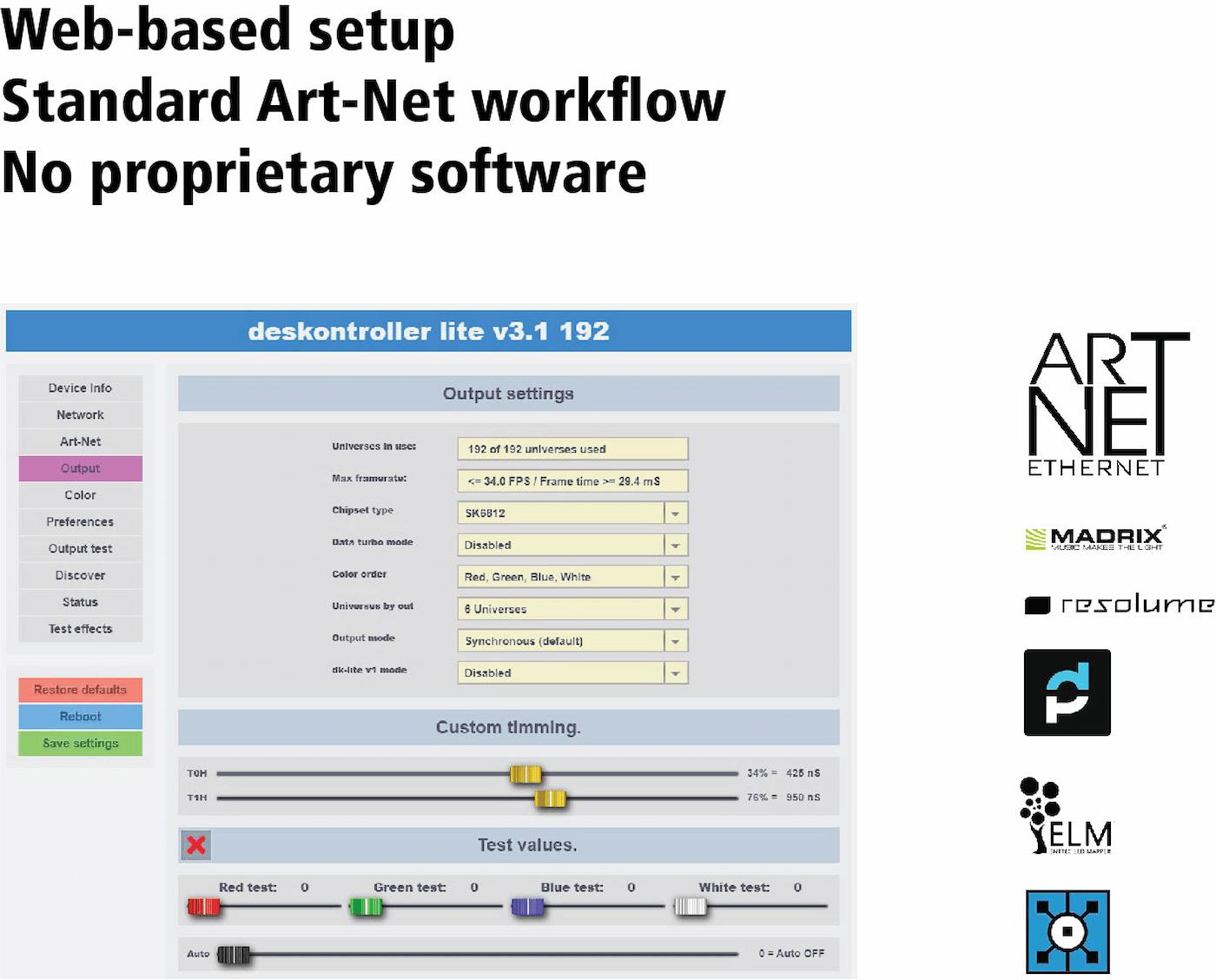
The deskontroller LITE V3 32U is designed to integrate into standard Art-Net workflows without forcing you into proprietary software or drivers.
- Browser-based setup through the unit Web UI
- Standard Art-Net workflow with widely used industry software
- No dependency on a closed software ecosystem
- Useful for integrators, rental, AV, studios and professional projects
If you need to validate the software side, review the setup guides for network interface, target IP, universe range, FPS and patch structure.
Compatible with the LED pixel families commonly used in real projects
The system is compatible with a wide range of LED pixel families used in professional integration, including clockless and clocked options, in both RGB and RGBW configurations.
- Compatible with over 100 IC families
- Support for clockless and clocked signal types
- Works with RGB and RGBW strips or pixels
- LED power supply is independent from the controller
- Protocol family, colour order and RGB/RGBW mode are configured globally on the unit
For compatibility details, IC families and protocol selection criteria, see the dedicated guide on deskontroller.com.
Quick summary
Help refine the choice
If you want to validate this model within the range, check output distribution or plan future capacity, these are the most useful routes.
What changes as you move up the range
The whole range shares the same physical architecture. What changes from one model to another is the total number of universes, the approximate capacity per output and the balance between distribution and load.
| Model | Universes | Max. FPS | Approx. RGB | Approx. RGBW | Normal mode | V1 / clock | Focus |
|---|---|---|---|---|---|---|---|
| 32UCurrent | 32 | ~102 | 5,440 | 4,096 | 1 universe/output | 2 universes/output | Highest FPS headroom |
| 64U | 64 | ~80 | 10,880 | 8,192 | 2 universes/output | 4 universes/output | More load per line |
| 96U | 96 | ~60 | 16,320 | 12,288 | 3 universes/output | 6 universes/output | Mid-to-large scale balance |
| 128U | 128 | ~48 | 21,760 | 16,384 | 4 universes/output | 8 universes/output | Serious capacity for large format |
| 160U | 160 | ~38 | 27,200 | 20,480 | 5 universes/output | 10 universes/output | High capacity for demanding projects |
| 192U | 192 | ~30 | 32,640 | 24,576 | 6 universes/output | 12 universes/output | Maximum capacity in the range |
Art-Net hardware for serious installations, with real support
The deskontroller LITE V3 32U is built for integrators, lighting professionals, rental, AV and studios that need an Art-Net controller that is clear to configure, stable in the installation and easy to document.
It keeps the approach that defines the deskontroller range: 32 physical outputs, Web UI setup, no dedicated software required, European manufacturing and a 5-year warranty.
Trust signals
- Made in Europe
- 5-year warranty on deskontroller products
- Architecture designed to distribute load more cleanly
- Compatible with standard Art-Net workflows
- Documentation and technical support available
-
ReferenceDKLITEV3-32
-
MPNDKLITEV3-32